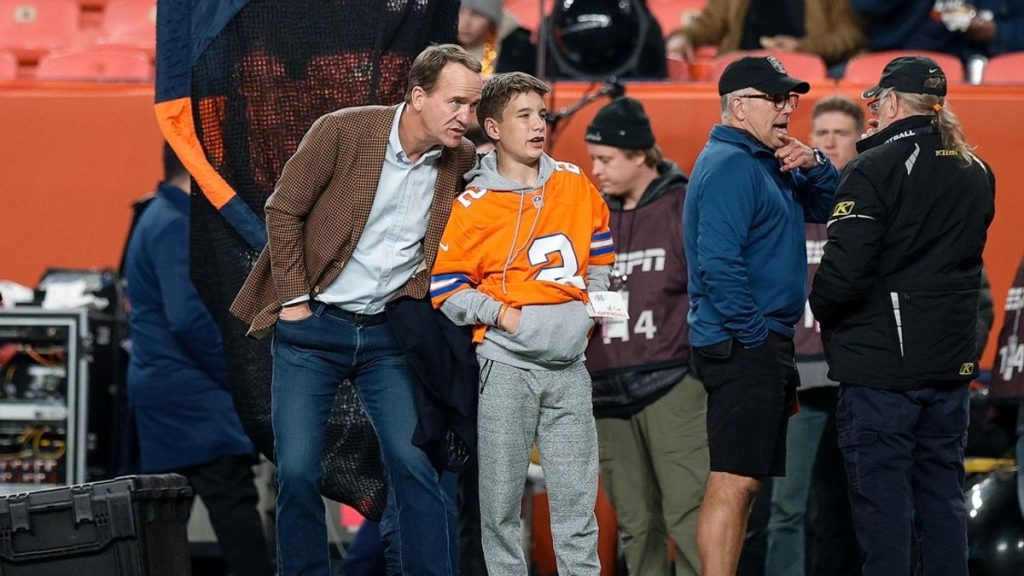

Another Manning has entered the quarterback pipeline, ready to start his odyssey as a high school freshman.
Marshall Manning, the son of Pro Football Hall of Fame quarterback Peyton Manning, will enter Baylor School in Chattanooga, Tenn., as a member of the Class of 2030.
Head coach Erik Kimrey confirmed this week that the younger Manning will serve as the backup to Keegan Croucher, a four-star recruit who has committed to the Ole Miss 2027 class. The 247Sports composite lists Croucher as the No. 11 quarterback prospect in the class.
“We’re excited about him,” Kimrey said.
Marshall is 15 and Peyton’s only son. Marshall has a twin sister, Mosley.
247Sports lists him at 5-foot-9, 150 pounds, but given his family’s lineage, Marshall likely is due for a huge growth spurt.
His dad and his Uncle Eli, both two-time Super Bowl winners, are 6-5. Grandpa Archie, a former NFL quarterback, is 6-3. And his cousin, Arch, is 6-4 and the expected starter at quarterback at Texas in the 2026 season.
The Baylor School is a football powerhouse known to produce players who go on to major college programs, like Croucher. Also on the team’s roster and part of the 2027 class is running back David Gabriel Georges, listed as the No. 2 player at his position and No. 10 overall in the nation by the 247Sports composite. He has not chosen a school but is being courted by numerous Power Four schools.
The team is No. 12 in the 2026 MaxPreps Preseason Top 25 Rankings.
Marshall might not be the end of the Manning quarterback line. While the children of his Uncle Cooper — that includes Arch — are grown, Uncle Eli is a father of three girls and an 8-year-old boy, Charlie.
–Field Level Media
PakarPBN
A Private Blog Network (PBN) is a collection of websites that are controlled by a single individual or organization and used primarily to build backlinks to a “money site” in order to influence its ranking in search engines such as Google. The core idea behind a PBN is based on the importance of backlinks in Google’s ranking algorithm. Since Google views backlinks as signals of authority and trust, some website owners attempt to artificially create these signals through a controlled network of sites.
In a typical PBN setup, the owner acquires expired or aged domains that already have existing authority, backlinks, and history. These domains are rebuilt with new content and hosted separately, often using different IP addresses, hosting providers, themes, and ownership details to make them appear unrelated. Within the content published on these sites, links are strategically placed that point to the main website the owner wants to rank higher. By doing this, the owner attempts to pass link equity (also known as “link juice”) from the PBN sites to the target website.
The purpose of a PBN is to give the impression that the target website is naturally earning links from multiple independent sources. If done effectively, this can temporarily improve keyword rankings, increase organic visibility, and drive more traffic from search results.